Russia running out of fuel: Analysis
The Moscow refinery was recently hit by Ukrainian drones, which led to large disruptions in production and is currently causing a shortage of fuel in Moscow. How serious is the impact and is the shortage a temporary disruption or a long-term problem?
The total refining capacity of Russia is 6.5-6.6 million bpd, but Russia has historically had significant spare refining capacity, processing around 5.5 million bpd, meaning the country’s spare refining capacity is around one million bpd.
Demand for oil products in Russia
|
Product |
Demand |
|
Gasoline |
870,000 bpd |
|
Diesel |
916,000 bpd |
|
Jet fuel |
218,000 bpd |
|
Fuel oil |
400,000 bpd |
|
LPG |
900,000 bpd |
|
Total |
3,300,000 bpd |
Disrupted refineries
Currently, the disrupted (fully or partially) refineries are: Ryazan (fully), Moscow (heavily), Yaroslavl (heavily), Kirishi (partially), NORSI (almost fully), Perm (partially), TANECO (fully), Syzran (heavily), Tuapse (fully). Unfortunately, we do not have any official confirmation, but these are the refineries that were reportedly hit.
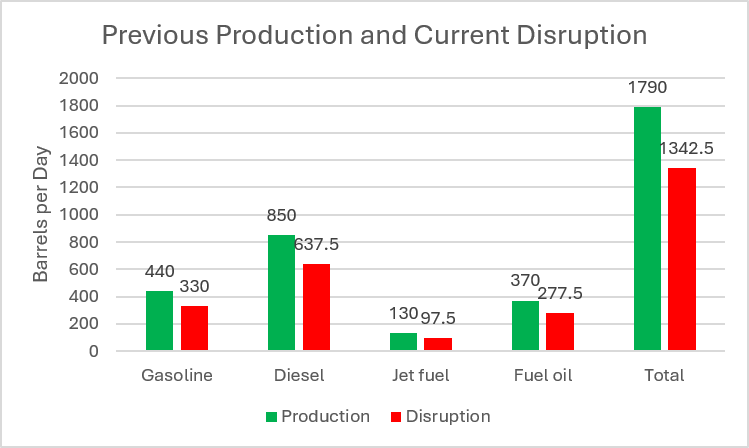
The chart above shows the estimated total production of the disrupted refineries before they were attacked (split by product), and the estimated disruption to these refineries (an optimistic assumption that the disrupted refineries are still averaging 25% production was used).
The total disruption is estimated to be 1.342 million bpd. With potential refining spare capacity being around one million bpd, it is already clear that just increasing the domestic production of fuels to the maximum is not going to be enough to escape shortages. Even with an optimistic assumption that the disrupted refineries are still working at 25% capacity, the disruption is still greater than the potential spare capacity.
Possible solutions
1. Cut exports. Russia is exporting 2.3-2.4 mbpd of oil products. If the currently undisrupted refineries start working at full capacity, the exports will have to be cut down by approximately 350-450 kbpd, costing the country $22-28 million per day. An uncomfortable, but feasible loss.
2. Import. Russia had imported oil products from Belarus during previous disruptions.
3. Making yet another optimistic assumption that the damaged refineries might be fixed in recent weeks, then Russia can draw products from strategic fuel reserves while waiting.
Most likely scenario: cutting exports. This choice is supported by recent information that Russia is considering a complete diesel export ban.